Before You Blame Your Brain, Test Your Nose
If an antihistamine is the only thing that puts you out, your insomnia may be allergic rather than neurological. But the drug working isn't the proof you think.

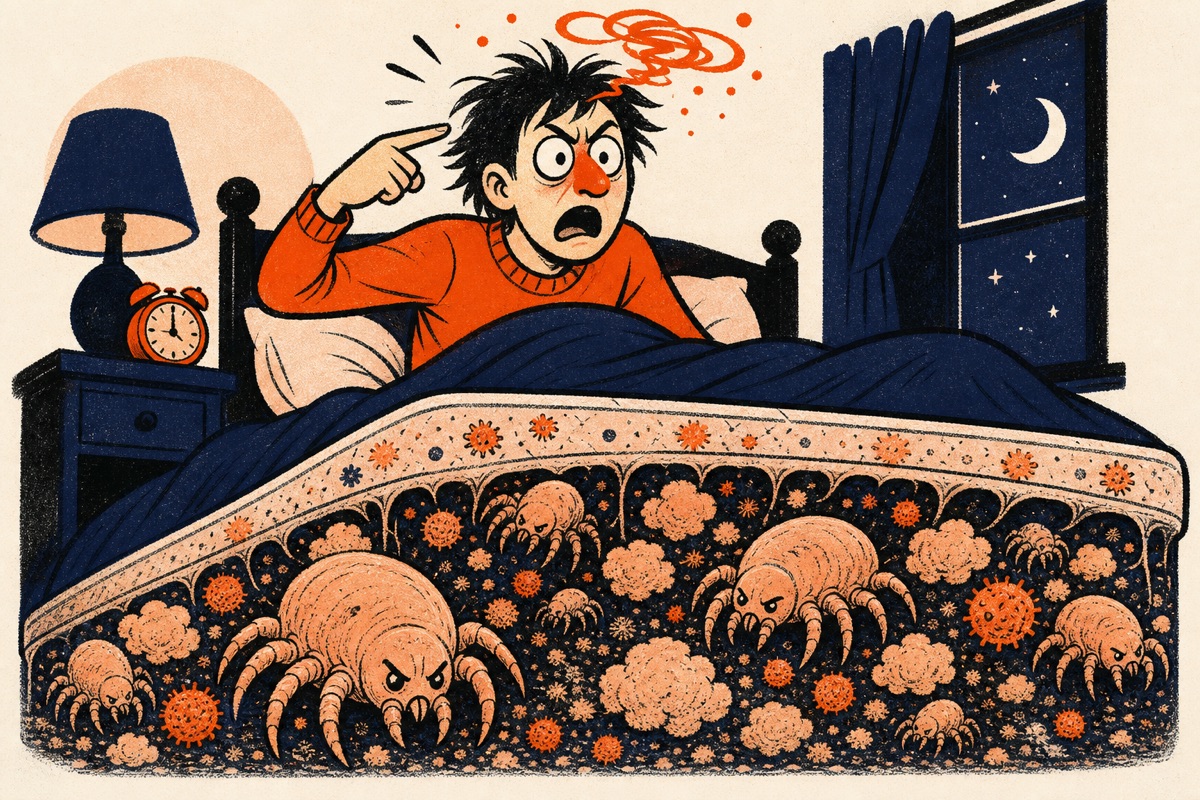
An antihistamine is the only thing that reliably puts you out. So the obvious conclusion is that you've got too much histamine, and that's what's keeping you awake.
Half right, and the wrong half matters. The fact that the drug works is not evidence of anything — blocking brain histamine receptors sedates people with perfectly normal histamine. But there is a real version of this idea, it's common, and it's the difference between a sleep problem in your brain and a mechanical problem in your nose. Those have completely different fixes.
If you read nothing else
- "The antihistamine works, so I have too much histamine" doesn't follow. Aspirin curing a headache isn't evidence of aspirin deficiency.
- There is no test and no established diagnosis for central histamine-excess insomnia. The measured research runs the opposite direction.
- Allergic disease disrupting sleep is real, common, and testable. That's the version of this idea worth chasing.
- Your bed is where dust mite exposure peaks — which explains a strictly nocturnal problem better than brain chemistry does.
- If it is allergic, an antihistamine is the second-best treatment. Steroid nasal spray beats it in head-to-head data.
Why isn't the drug working proof of anything?
Because that's what the drug does to everybody.
Histamine is one of your brain's main wake-promoting systems. Block its H1 receptors and you turn down cortical responsiveness — that's the drowsiness, and it happens regardless of whether your histamine levels were high, low, or unremarkable. A single 2 mg dose of chlorpheniramine occupies 76.8% of frontal cortex H1 receptors. At that level of blockade, sedation isn't a clue about your physiology. It's arithmetic.
Your response tells you the histamine-to-wakefulness pathway is intact. It doesn't tell you it's overactive.
There's a second problem: the old antihistamines aren't clean probes. Chlorpheniramine is also a potent anticholinergic — it's used clinically for exactly that — with some serotonergic activity on top. A response to it is a response to at least three mechanisms at once, and you can't tell which one did the work by feel.
Is "too much brain histamine" even a real thing?
The direction is biologically sound. The clinical entity isn't established.
Raising brain histamine reliably produces wakefulness — that's demonstrated, not theoretical. Blocking the enzyme that breaks histamine down in the brain increases histamine levels, promotes wakefulness and prolongs sleep latency, and does it through H1 without touching dopamine, norepinephrine, or serotonin. More histamine, more wake. Clean.
But the human measurements run the other way. Reduced spinal-fluid histamine is what's documented — in narcolepsy and idiopathic hypersomnia, disorders of too much sleep. Nobody has demonstrated an elevated-histamine insomnia phenotype, there's no test for it, and there's nothing to prescribe for it. If that's what you have, no one can currently confirm it or treat it directly.
What's the version of this that's actually worth chasing?
Peripheral histamine. Your nose, not your cortex.
Allergic rhinitis is one of the better-documented sleep disruptors there is, and it works through completely unmysterious mechanisms: congestion, itching, post-nasal drip, narrowed airway. It's associated with poorer sleep quality, daytime sleepiness, and a well-mapped two-way relationship with mood. This is your hypothesis, just below the neck — and unlike the brain version, it's diagnosable and treatable.
The single strongest clue that this is you: dust mite exposure peaks in bed.
Think about what that explains. If your problem is specifically nocturnal and specifically in your bedroom, an allergic mechanism accounts for the localization in a way "my brain makes too much histamine" simply doesn't. Brain chemistry doesn't know what room you're in. Your mattress does.
Other signals pointing the same direction: congestion that worsens when you lie down, waking with a blocked nose or sneezing fits, post-nasal drip, itching or hives, a seasonal pattern, or symptoms after histamine-rich foods like aged cheese, red wine, or leftovers.
How would you tell the difference?
This is the useful part, and it's genuinely discriminating.
The newer antihistamines — fexofenadine, bilastine, and to a lesser extent loratadine and cetirizine — block peripheral histamine but barely enter the brain. The PET numbers make the gap obvious: loratadine 10 mg occupies 11.7% of cortical H1 receptors against chlorpheniramine's 53–77%, and bilastine has the lowest cerebral occupancy of the whole second-generation class.
That makes them a clean probe for separating the two mechanisms:
- Sleep improves on a non-sedating antihistamine → the benefit was peripheral. Your insomnia has an allergic component, and you can pursue that without the anticholinergic load.
- Nothing changes → the benefit was central sedation, not histamine excess. Your sleep problem is something else, and the old drug was covering it up.
Either answer is worth having, and this is exactly the question to bring to a doctor rather than to work out alone in the pharmacy aisle. Bring the specifics: what you take, how long you've taken it, whether your nose is blocked at night, and whether the problem follows you when you sleep somewhere else. That last one is diagnostic gold and costs nothing.
If it is allergic, what's the actual answer?
Not an antihistamine — or not only one.
For allergic rhinitis, steroid nasal sprays outperform antihistamines on the sleep outcome specifically. A meta-analysis of 18 randomised trials covering 6,019 participants found intranasal corticosteroids improve sleep quality in allergic rhinitis. In a head-to-head randomised trial against cetirizine, nasal beclomethasone beat it on the Pittsburgh Sleep Quality Index (−1.30 versus −0.19) and on nasal volume, symptom score, and inflammatory cell counts.
And the free interventions are real here in a way they usually aren't. Mattress and pillow encasements, hot-wash bedding, getting the humidity down, keeping pets off the bed — if your allergen exposure is concentrated where you sleep, changing where you sleep changes the exposure. You don't need to buy a drug to test that idea.
What to do with this
Stop reading the drug's effect as a diagnosis. It's the least informative signal you have, and it's the one everyone anchors on.
Ask the localization question. Is your sleep worse in your own bed than in a hotel? Worse in one season? Worse with a blocked nose? Those answers narrow the mechanism faster than any theory about your neurotransmitters.
Then work the order of operations. If it's not allergic, the usual suspects are still waiting — a body clock running late, arousal at bedtime, or sleep you're getting but not registering. And if the pill you take gets you down but drops you at 3am, that's a different mechanism entirely.
Whatever the answer, the trap is the same one this whole site keeps pointing at: the thing that makes you feel better tonight is not automatically the thing that's wrong. Sedation is a very convincing counterfeit — which is its own article, and worth reading before you settle on a nightly anything.
Start where everything here starts: fix your sleep first.
Questions people actually ask
Can allergies actually cause insomnia?
Yes, and it's one of the better-documented sleep disruptors. Allergic rhinitis fragments sleep through congestion, itching, post-nasal drip, and airway narrowing. It's also linked to obstructive sleep apnea. This is a mechanical problem below the neck, not a problem with your brain.
Does an antihistamine helping me sleep mean I have too much histamine?
No. Blocking brain H1 receptors sedates people with completely normal histamine levels — that's simply what happens when you suppress a wake-promoting system. A single 2 mg dose of chlorpheniramine occupies roughly 77% of frontal cortex H1 receptors. The drug working tells you the pathway is intact, not that it's overactive.
Why would my allergies only bother me at night?
Because your bed is where dust mite exposure peaks. If your sleep problem is specifically nocturnal and specifically in your own bedroom, an allergic mechanism explains that localization far better than a general theory about your brain chemistry does. Brain chemistry doesn't know which room you're in.
Is there a test for having too much histamine in your brain?
No. There's no established clinical entity of central histamine-excess insomnia and no diagnostic test for it in routine use. The measured human research runs the other direction entirely — reduced spinal-fluid histamine is what's documented, and it's found in disorders of excessive sleepiness rather than insomnia.
Sources
- The relationship between allergic rhinitis and sleep disorders and mental health — Frontiers in Allergy (2026)
- Effectiveness of intranasal corticosteroids for sleep disturbances in patients with allergic rhinitis: a systematic review and meta-analysis — International Archives of Allergy and Immunology (2025)
- Comparative effect of beclomethasone dipropionate and cetirizine on acoustic rhinometry parameters in children with perennial allergic rhinitis: a randomized controlled trial — Journal of Investigational Allergology and Clinical Immunology (2018)
- Bilastine: a new antihistamine with an optimal benefit-to-risk ratio for safety during driving — Expert Opinion on Drug Safety (2016)
- Brain histamine H1 receptor occupancy of loratadine measured by PET: comparison with d-chlorpheniramine — Human Psychopharmacology (2011)
- Histamine H1 receptor occupancy in human brains after single oral doses of H1 antagonists measured by PET — British Journal of Pharmacology (1995)
- Impact of antiallergy agents on CPAP therapy and sleep quality with spring pollinosis — Sleep and Breathing (2023)
- Enhanced histaminergic neurotransmission and sleep-wake alterations: a study in histamine H3-receptor knock-out mice — Neuropsychopharmacology (2013)
- Histamine N-methyltransferase inhibition as a novel therapeutic strategy for idiopathic hypersomnia — European Journal of Pharmacology (2026)
- CSACI position statement: newer generation H1-antihistamines are safer than first-generation H1-antihistamines — Allergy, Asthma & Clinical Immunology (2019)
This is educational content and personal experimentation — not medical advice. Talk to your doctor before changing medication, supplements, or treatment. Full disclaimer.
The list
One protocol at a time, to your inbox.
No 30-day email courses. No PDFs you'll never open. When a protocol survives testing, you get the write-up. Unsubscribe anytime.