Your Sleeping Pill Quits Before You Do: The Half-Life Trap
You fall asleep fine and wake at 3am anyway. A drug's half-life tells you how long it stays in your body — not how long it keeps working. Different numbers.

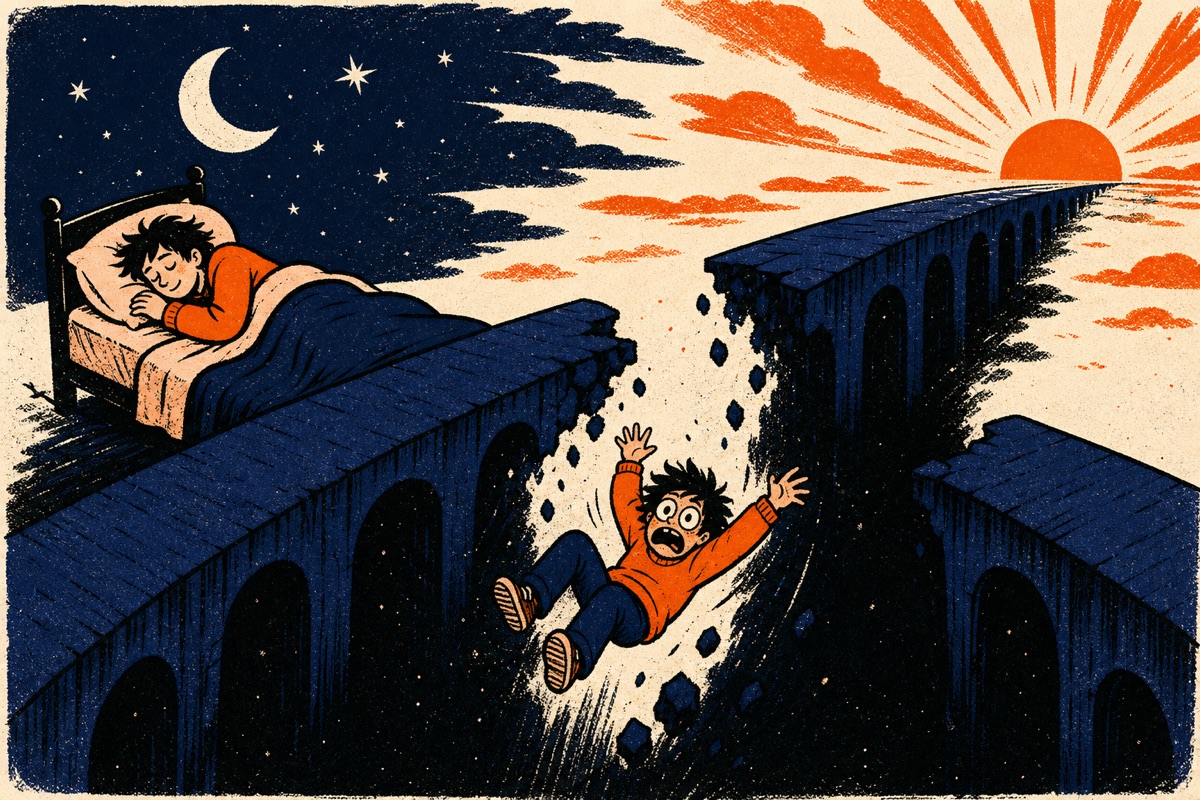
You fell asleep on schedule. You woke at 3am anyway. And the drug is supposedly long-acting, so that shouldn't happen.
It happens constantly, and the reason is a number almost everyone reads wrong. A drug's half-life tells you how long it takes your body to clear it. It does not tell you how long it keeps working on your brain. For some sleep drugs those two numbers differ by a factor of five or more — long enough to still be groggy at breakfast from a drug that stopped helping you before midnight.
If you read nothing else
- Half-life measures clearance from the body. Duration of effect measures the brain. They are different numbers and they can diverge wildly.
- Diazepam's elimination half-life averages 44 hours — but its measured brain effect is back to baseline within 6 to 8 hours.
- The reason is redistribution: fat-soluble drugs flood the brain, then drain out into body fat long before they're eliminated.
- This gives you the worst of both ends — the effect ends early, the residue stays for days.
- Sedation is the first effect you build tolerance to, often within about a week. The fade is real and dose escalation is not the answer.
What's the difference between half-life and how long a drug works?
Half-life is a clearance number. It says how long your liver and kidneys take to remove half the drug from your bloodstream. It's genuinely useful — for predicting accumulation, interactions, and how long a drug shows up on a test.
It says almost nothing about how long the drug occupies your brain.
A drug's effect ends when it leaves the receptors it's acting on. That can happen for two reasons: the body eliminated it, or the drug simply moved somewhere else. For fat-soluble drugs, the second happens far faster than the first — and the brain is the first place they reach and one of the first places they leave.
How much can those two numbers differ?
For diazepam, dramatically — and it's been measured directly rather than inferred.
Researchers gave healthy volunteers intravenous diazepam and tracked its effect on the brain by EEG while simultaneously measuring plasma levels. The results:
- Elimination half-life: 33 hours in that study; 44.2 hours in a separate 48-person sample.
- EEG effect above baseline: about 5 hours.
- EEG effect indistinguishable from baseline: 6 to 8 hours.
The drug was still abundantly present in the body when it had stopped doing anything measurable to the brain. The authors' own conclusion was that distribution, not elimination, is what terminates the effect.
Those studies used intravenous dosing, which front-loads the effect more sharply than a tablet does. The onset is gentler by mouth. The redistribution that ends the effect is the same either way.
Why is that the worst possible shape for a night?
Because a night is roughly eight hours and this effect curve isn't.
You get a strong front-loaded hit that gets you down, then a decay that lands you awake somewhere in the back half of the night — the exact hours when sleep is naturally lighter and easier to break anyway. That's the 3am wake, and it's the same 3am that a stimulation-hungry brain is only too happy to fill.
Meanwhile the drug hasn't gone anywhere. Diazepam produces an active metabolite, desmethyldiazepam, that outlasts the parent compound considerably. With repeated dosing this accumulates — and in older adults the effect is stark: diazepam's mean half-life measured 86 hours in elderly subjects versus 31 hours in young ones in the same study.
So you carry the drug into tomorrow without carrying the benefit through tonight. Next-day dullness, no extra sleep.
Contrast that with a drug whose exposure curve happens to fit. Chlorpheniramine — an ordinary antihistamine, not a designed hypnotic — has an elimination half-life of about 20 hours with extensive tissue distribution and no sharp redistribution cliff. It isn't better designed. Its curve just happens to be closer to the length of a night, which is a large part of why some people find a cold-and-flu tablet more useful for sleep than a sedative that looks far stronger on paper. That is a statement about shape, not about safety — and the safety side of that trade is its own article.
Is Valium supposed to be a sleeping pill at all?
No, and this is worth knowing if you've been treating it as one.
The AASM's guideline for chronic insomnia evaluates every drug with usable evidence and issues a recommendation for or against each. Zolpidem, eszopiclone, zaleplon, temazepam, triazolam, ramelteon, suvorexant, and doxepin all get recommendations. Trazodone, diphenhydramine, melatonin, and valerian get recommendations against.
Diazepam doesn't appear at all.
The benzodiazepines that made the list are temazepam and triazolam — and now you know why it's those. They are shaped for a night. Diazepam is an anxiolytic, muscle relaxant, and anticonvulsant that produces sedation as a side effect. It is not a failed sleeping pill. It was never entered in that race.
Why did it stop working after a couple of weeks?
Because sedation is the effect you lose first.
Diazepam's acute sedative action runs through α1 GABA-A receptors. In knock-in mice, robust tolerance to the motor-depressant effect appears within about eight days of daily dosing while other effects persist. Anxiolysis outlasts sedation considerably.
So a drug that reliably knocked you out in week one can leave you lying awake and still anxiolysed in week four. Nothing has gone wrong with you. You are experiencing the normal, expected time course of the drug, and raising the dose buys a short reprieve at the cost of a steeper eventual withdrawal.
What to do with this
Nothing to buy here. Three things to change in how you read your own nights:
Stop treating "still in my system" as "still working." Morning grogginess is not evidence that the drug covered your night. It is frequently evidence of the opposite: the residue outlasted the effect.
Diagnose the shape of the failure, not just the failure. Can't fall asleep, or can't stay asleep? Those are different problems with different mechanisms and different answers — sleep-onset trouble points toward a late body clock or bedtime arousal; a reliable 3am wake points here, or at breathing, or at something in the room. The pill that fails at 3am is telling you which one you have.
Take the fade seriously as information. A drug that worked and stopped is not a drug that needs a bigger dose. It's a signal that the problem underneath was never the one the drug was treating.
The whole sequence starts in one place: fix your sleep first. Not because it's easy, but because every pharmacological shortcut here has a shape — and none of them are shaped like a night.
Questions people actually ask
Why do I wake at 3am even though I took a sleeping pill?
Because how long a drug stays in your body and how long it works on your brain are different numbers. Highly fat-soluble drugs flood the brain fast, then redistribute out into body fat well before they're eliminated. The effect ends; the drug stays.
Is Valium a sleeping pill?
Not by the guidelines. Diazepam doesn't appear in the AASM's recommendations for chronic insomnia at all — not as recommended, not as recommended against. The benzodiazepines that do appear are temazepam and triazolam. Diazepam is an anxiolytic, muscle relaxant, and anticonvulsant that happens to produce sedation as a side effect.
If a drug has a long half-life, shouldn't it last all night?
No, and this is the most common misreading in pharmacology. Elimination half-life describes clearance from the body. Duration of effect is often set by redistribution out of the brain, which can be many times faster. One can be 44 hours while the other is under 8.
Why did my sleeping pill stop working after a couple of weeks?
Sedation is usually the first effect you lose. In animal work, tolerance to diazepam's motor-depressant effect appears within about eight days of daily dosing, while other effects persist. You aren't imagining the fade, and increasing the dose isn't the fix.
Sources
- Pharmacokinetic and electroencephalographic study of intravenous diazepam, midazolam, and placebo — Clinical Pharmacology & Therapeutics (1989)
- A large-sample study of diazepam pharmacokinetics — Therapeutic Drug Monitoring (1989)
- Kinetic and dynamic study of intravenous lorazepam: comparison with intravenous diazepam — Journal of Pharmacology and Experimental Therapeutics (1989)
- Slow accumulation and elimination of diazepam and its active metabolite with extended treatment in the elderly — Journal of Clinical Pharmacology (2021)
- Requirement of alpha5-GABAA receptors for the development of tolerance to the sedative action of diazepam — Journal of Neuroscience (2004)
- Relevant pharmacokinetics, bioavailability, and bioequivalence studies on chlorpheniramine maleate: a review — Frontiers in Pharmacology (2025)
- Clinical practice guideline for the pharmacologic treatment of chronic insomnia in adults (AASM) — Journal of Clinical Sleep Medicine (2017)
- Non-benzodiazepines for the treatment of insomnia — Sleep Medicine Reviews (2000)
This is educational content and personal experimentation — not medical advice. Talk to your doctor before changing medication, supplements, or treatment. Full disclaimer.
The list
One protocol at a time, to your inbox.
No 30-day email courses. No PDFs you'll never open. When a protocol survives testing, you get the write-up. Unsubscribe anytime.