Why Your ADHD Brain Won't Sleep Until 3am: The Circadian Mechanism
Not a discipline problem: in ADHD adults with sleep-onset insomnia, melatonin arrives ~1.5 hours late. Your clock is set wrong. Here's how to move it.

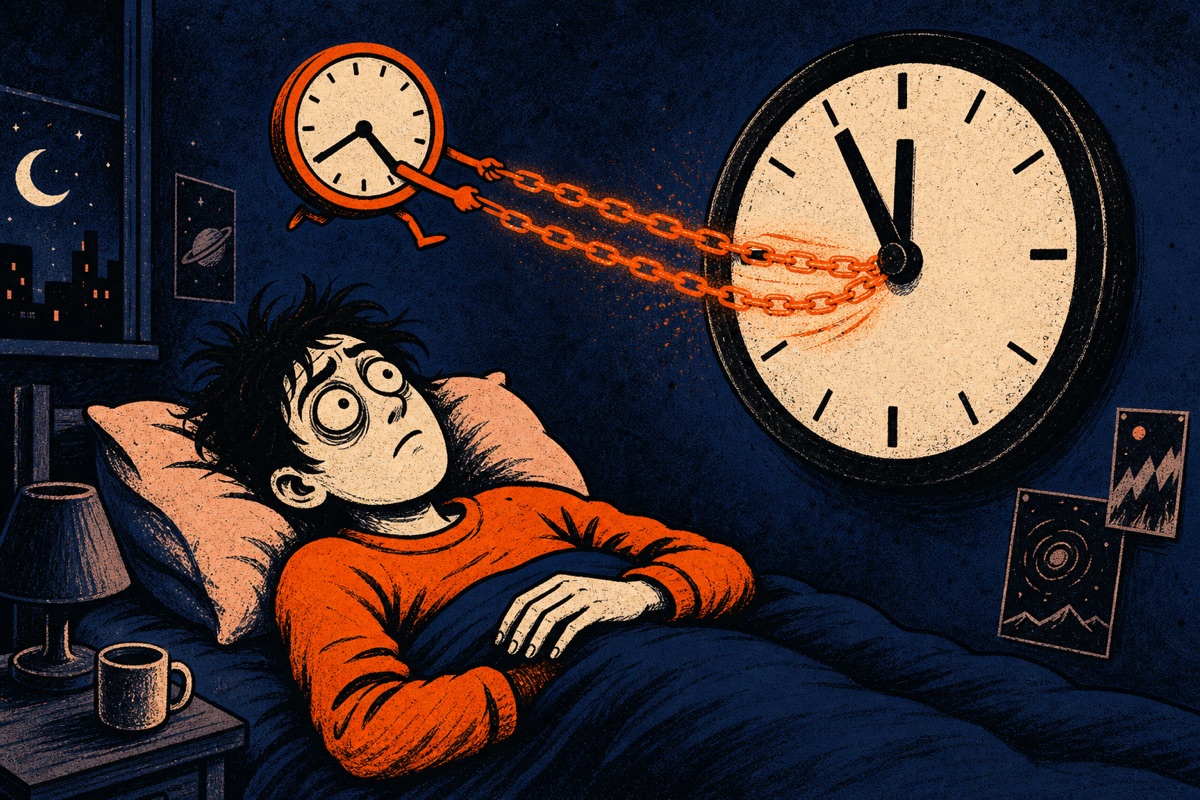
Here's the sentence that changes how you see your bedtime: you are not bad at going to sleep — your clock is set to the wrong timezone.
Every night you lie down at a "reasonable" hour and your brain treats it like a fire drill, you're not failing at discipline. You're trying to fall asleep during your biological afternoon.
If you read nothing else
- In ADHD adults with sleep-onset insomnia, dim-light melatonin onset arrives ~1.5 hours later than in non-ADHD adults. The clock itself is shifted.
- This is functionally delayed sleep phase, not classic insomnia — so the fix is clock-shifting (light timing), not sleeping pills or willpower.
- The levers, in order of power: anchored wake time, morning bright light, evening light restriction, then optionally timed low-dose melatonin (with your doctor).
- Expect 2–4 weeks of boring, gradual shift. There is no fast version. There is a working version.
The mechanism in plain terms
Your body runs a ~24-hour master clock. Every evening, it releases melatonin — the "start preparing for sleep" signal. In non-ADHD adults that signal typically arrives mid-evening.
In adults with ADHD and chronic sleep-onset insomnia, researchers measured when that melatonin signal actually shows up. The answer: on average about an hour and a half later. Same finding in ADHD kids. Evening chronotypes — genuine night owls by biology, not preference — are massively overrepresented in ADHD, and the ADHD-circadian literature keeps tightening the link, down to clock-gene associations.
So at 11pm, when the internet tells you to be winding down, your brain is where a normal brain was at 9:30. Nothing in you is "refusing" sleep. The signal hasn't fired yet.
Then ADHD pours fuel on it
A delayed clock alone would be manageable. ADHD adds a second mechanism: the night is the day's best dopamine deal. Quiet house, zero obligations, nobody needing anything from you. For a brain that spent all day white-knuckling through under-stimulating tasks, midnight feels like the first honest hour — so you spend it. That's revenge bedtime procrastination, and on top of a shifted clock it turns a 1.5-hour delay into a 3am problem.
Notice the structure: a biological delay plus a behavioral amplifier. You can't willpower the biology, and you can't out-biology the behavior. You need to work both — but the clock comes first, because a shifted clock makes the behavioral fight unwinnable.
How to actually move the clock
Light is the master input. Your clock sets itself by when bright light hits your eyes. That gives you three levers, ranked:
1. Anchor the wake time. Same wake time, seven days a week, non-negotiable, even after a bad night. A wake time that swings two hours on weekends re-jetlags you every Monday. This is the single most boring instruction on this site and the one everything else depends on.
2. Flood the first hour with light. Bright light shortly after waking pulls the clock earlier — it's the strongest phase-advance signal there is. Best version: outside, ten to twenty minutes, no sunglasses. Overcast counts; outdoor light beats indoor light by an order of magnitude. Dawn-simulation and bright-light devices exist for dark winters and brutal schedules — an early open trial of morning light in ADHD adults even showed phase advance and attention improvements — but the sun is free and stronger. Hardware comparison, if you want it: sunrise alarms that actually work.
3. Starve the evening of light. Bright light late at night pushes your already-late clock even later — and there's evidence ADHD eyes may be extra sensitive to it. Two hours before target bedtime: lights low and warm, screens dim or off. Don't aim for monastic perfection; aim for "the kitchen doesn't look like an operating theater at 11pm."
Optional lever four — melatonin, used correctly. Melatonin as most people take it (a big dose at bedtime) is a weak sleeping pill. Melatonin as chronobiology uses it is a clock-shifting signal: roughly 0.5mg taken 3–5 hours before target sleep, i.e. early evening — where meta-analysis shows it genuinely advances a delayed phase. Counterintuitive timing, tiny dose. Talk to your doctor before starting it, especially alongside ADHD medication; this is a mechanism explainer, not a prescription.
What to expect
The clock moves 15–30 minutes a week when you're consistent. That means two to four weeks before your body is genuinely ready for sleep at your target time — during which you still have to survive each individual night. That's a different problem with a different tool: the racing-thoughts wind-down protocol.
And if any of this "delayed clock" description didn't land — if your problem is less "not sleepy until 3am" and more "exhausted but my brain won't shut up" — you may be dealing with hyperarousal rather than (or on top of) phase delay. Same article covers how to tell them apart.
The foundation piece, if you skipped it: Fix Your Sleep First.
You've spent years fighting your clock and calling the losses a character flaw. Fight the actual enemy. It moves — slowly, boringly, reliably — when you push on the right lever.
Questions people actually ask
Is ADHD linked to delayed sleep phase disorder?
Strongly. Most ADHD adults with sleep-onset insomnia show a delayed circadian rhythm: melatonin onset arrives around 1.5 hours later than in non-ADHD adults, and evening chronotypes are heavily overrepresented. Functionally, many ADHD sleep problems are delayed sleep phase, not insomnia in the classic sense.
How do I shift my ADHD body clock earlier?
Anchor your wake time seven days a week, get bright light within the first hour of waking, and dim light aggressively in the two hours before target bedtime. Expect two to four weeks of gradual shift. Light timing is the strongest lever; consistency beats intensity.
Does melatonin work for ADHD sleep problems?
Timed low-dose melatonin (roughly 0.5mg, taken 3–5 hours before target sleep) can advance a delayed clock — that's a chronobiotic use, not a sedative one. Taking 10mg at midnight is the common mistake. Discuss dosing and timing with your doctor before starting.
Why does my ADHD brain come alive at night?
Two stacked effects: your delayed clock means your biological evening starts later, so alertness peaks when others wind down — and the quiet, obligation-free night is the day's richest source of unclaimed dopamine, which makes staying up feel like self-repair. That's also why revenge bedtime procrastination hits ADHD harder.
Sources
- Delayed circadian rhythm in adults with attention-deficit/hyperactivity disorder and chronic sleep-onset insomnia — Biological Psychiatry (2010)
- The circadian rhythm in adult attention-deficit/hyperactivity disorder: current state of affairs — Expert Review of Neurotherapeutics (2013)
- The use of exogenous melatonin in delayed sleep phase disorder: a meta-analysis — Sleep (2010)
- An open trial of light therapy in adult attention-deficit/hyperactivity disorder — Journal of Clinical Psychiatry (2006)
This is educational content and personal experimentation — not medical advice. Talk to your doctor before changing medication, supplements, or treatment. Full disclaimer.
The list
One protocol at a time, to your inbox.
No 30-day email courses. No PDFs you'll never open. When a protocol survives testing, you get the write-up. Unsubscribe anytime.