Sedation Is Not Sleep: Why the Pill That Works Isn't Working
The drug knocked you out, so it worked — right? Measured in a lab, the pills that feel the most effective are often the ones degrading your sleep the most.

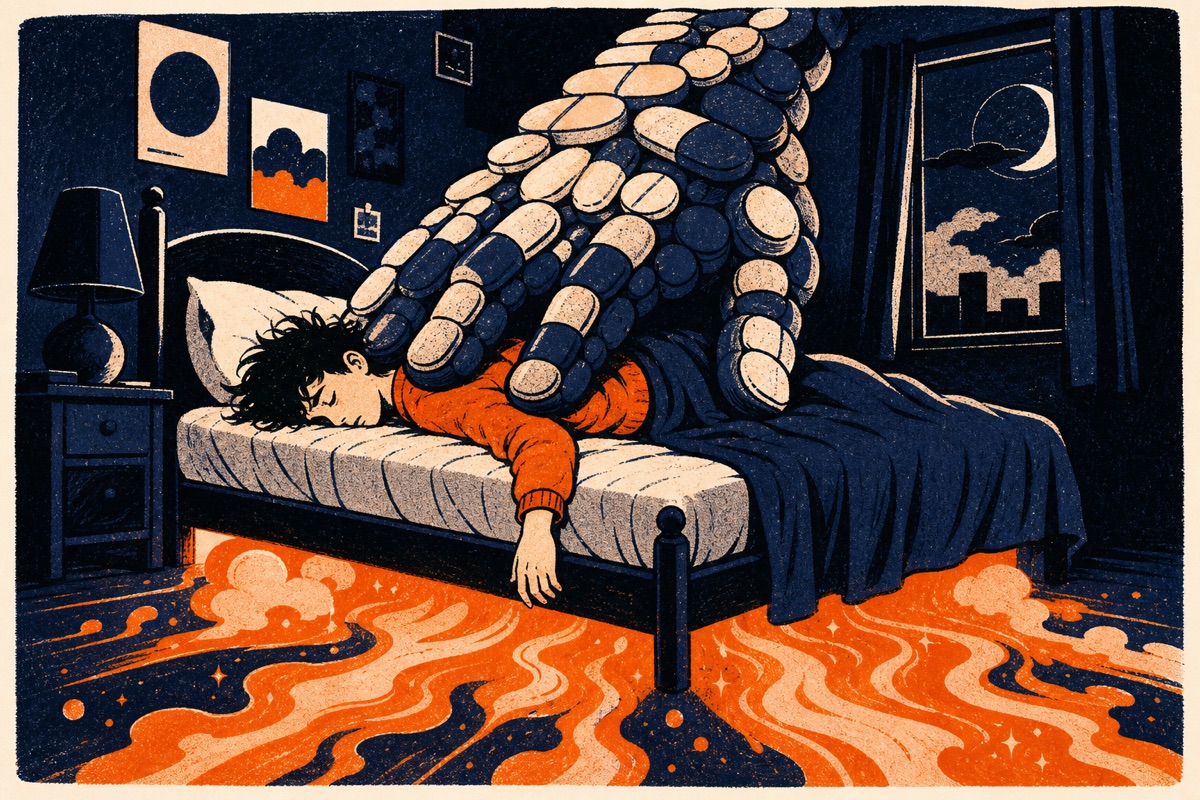
You took something. You went out like a light. So it worked.
Here's the problem: "it knocked me out" and "I slept well" are two different measurements, and drugs can move them in opposite directions. In a controlled trial, one benzodiazepine significantly reduced deep sleep while the people taking it rated their sleep quality as improved. Both results, same night, same subjects. The feeling of a sleep drug working is generated by a different mechanism than the restoration you're taking it for.
If you read nothing else
- Sedation and sleep are not the same brain state. Sedating drugs suppress the systems that keep you awake. They do not build the deep sleep that restores you.
- In a placebo-controlled trial, alprazolam cut slow-wave sleep while subjects rated their sleep as better. Your subjective read is not a reliable instrument here.
- Long-term benzodiazepine users show more light stage 2 sleep, less deep sleep, and less delta activity than their own drug-free sleep.
- You can be measurably impaired by a sedating antihistamine and not feel drowsy. The warning signal you'd rely on isn't reliable.
- Sleep guidelines recommend against over-the-counter antihistamines for chronic insomnia. This is not a fringe position.
What is actually happening when a drug makes you sleepy?
Start with the antihistamines, because the mechanism was worked out directly in human brain tissue and it's unusually clean.
Your cortical neurons leak potassium continuously through a background channel. That leak is what holds them quiet. When histamine binds its H1 receptor, that leak shuts down — the neuron drifts closer to firing, and every incoming signal lands harder. That's wakefulness at the cellular level: histamine doesn't fire your cortex, it turns up the gain on everything else.
Block H1 and you turn the gain back down. That's the drowsiness. Notice what it is not: it's not the construction of sleep. It's the removal of one system that opposes it.
Why doesn't the deep sleep show up?
Because the drugs that sedate you best are often the ones that interfere most with sleep's architecture.
Sleep isn't one thing. Slow-wave sleep — the deep, delta-heavy stage — does the bulk of the physical restoration. Lighter stage 2 does less. Benzodiazepines systematically trade the first for the second.
The cleanest demonstration is a placebo-controlled crossover in healthy volunteers. Alprazolam significantly reduced slow-wave sleep versus placebo. In the same study, participants rated the ease of getting to sleep and their perceived sleep quality as significantly improved.
That is the whole problem in one result. The measurement you have access to moved in the opposite direction from the measurement that matters.
It isn't a short-term artifact either. Insomnia patients who had taken benzodiazepines nightly for an average of nearly seven years were compared against their own sleep after withdrawal. On the drug: more stage 2, less slow-wave sleep, more sigma activity, less delta. Years of nights, quietly reshaped.
Why can't you just tell?
You'd expect to notice. The evidence says you can't rely on it.
In a PET study of d-chlorpheniramine, cognitive performance on an attention-demanding task deteriorated dose-dependently — and at the dose where that deterioration became statistically significant, there was no significant change in subjective sleepiness. The impairment was real and measurable. The feeling that would have warned you about it was absent.
That decoupling is the thread running through this entire article. Your internal sense of "this is working" is not tracking the thing you care about. It's tracking sedation.
Why does this matter more with ADHD?
One specific reason, and it's about the drug's other mechanism.
First-generation antihistamines are not only antihistamines. Chlorpheniramine is a potent anticholinergic — blocking acetylcholine, the system most directly tied to attention and working memory. It's used clinically for exactly those anticholinergic effects in other contexts.
So the nightly trade is this: you're spending the frontal-cortex resources you have least of. The PET blood-flow work found antihistamine effects concentrated in frontal, temporal, and anterior cingulate cortex — the attention regions. If frontal control is already your constrained resource, that's the account you can least afford to overdraft.
Be clear about the strength of that claim. Nobody has run a study showing ADHD brains are specifically more vulnerable to this. It's an inference from where the drug acts, and it's a reasonable one, but it's an inference. I'd rather say so than oversell it.
The long-run data is firmer and worth knowing. A Swedish nationwide case-control study of 199,526 people with incident dementia found a dose-response relationship for cumulative use of strong anticholinergics, reaching an adjusted odds ratio of 1.66 at the highest exposure band, with antihistamines named among the driving drug classes. That's older adults, it's associational, and it is not a verdict on any single night. But the exposure metric is cumulative dose over years — and "nightly, indefinitely" is how that number gets large.
So what do the guidelines actually say?
Bluntly, and it surprises most people:
The American Academy of Sleep Medicine's guideline for chronic insomnia recommends against diphenhydramine. Not "use with caution" — recommends against, alongside melatonin, valerian, and trazodone. Canada's allergy and immunology society goes further, recommending newer-generation antihistamines over first-generation ones on safety grounds and calling out their continued over-the-counter status as the reason the old ones persist.
The most popular sleep drugs in the pharmacy are the ones the sleep guidelines specifically tell clinicians not to use for this.
None of that means the sleep you're getting is fake, or that you've done something wrong. It means the tool is doing a narrower job than the label implies.
What to do with this
You don't need to buy anything for this part, and there's nothing to optimize here — this is a reframe, and the reframe is the whole intervention.
Stop using "it knocked me out" as your evidence. It's the one signal that reliably fails. Judge a sleep intervention on how the next day goes across a week — focus, mood, whether you needed the afternoon crash — not on how fast you went under.
Treat "I need something to sleep" as a question, not an answer. Insomnia driven by a delayed body clock, by nighttime arousal, and by an allergic or breathing problem all feel identical at 2am and need completely different fixes. Working out which one is yours is the actual work — start with the order of operations, check whether your clock is running late, and rule out the version where you slept more than it felt like.
If the pill quits on you halfway through the night, that's a separate mechanism with a separate explanation — and it's genuinely counterintuitive. That one's here.
And the obvious one, which is obvious for a reason: anything you're taking nightly to sleep is a conversation to have with a doctor, not a decision to keep making alone at 11pm. Especially if you've been making it for months.
ADHD is not an excuse and it's not a character flaw — it's a problem to solve, and this one has a solvable shape. The pill isn't lying to you. It's just answering a different question than the one you asked.
If the drug in question is a stimulant rather than a sedative, the evidence runs differently — and in both directions: trouble sleeping on Adderall.
Questions people actually ask
Do sleeping pills actually give you real sleep?
Not the same sleep. Benzodiazepines reliably cut slow-wave sleep — the deep stage that does most of the physical restoration — and replace it with lighter stage 2. You spend the same hours unconscious, but the night does less work. Your subjective rating usually improves anyway, which is the trap.
Why do I feel unrefreshed after taking something to sleep?
Because sedation and sleep are different brain states. A sedating drug suppresses the systems that keep you awake; it doesn't build the deep sleep that restores you. You lose consciousness on schedule and still wake up with the sleep debt largely unpaid.
Are antihistamines a safe way to sleep every night?
Sleep guidelines specifically recommend against them for chronic insomnia, citing limited efficacy and safety data. First-generation antihistamines also carry a strong anticholinergic load, and cumulative long-term use of strong anticholinergics shows a dose-dependent association with dementia risk. Talk to a doctor before making one a nightly habit.
How can a drug impair me if I don't feel drowsy?
Feeling drowsy and being impaired are measured separately, and they come apart. In one PET study, a standard antihistamine dose produced dose-dependent deterioration on attention tasks with no significant change in subjective sleepiness. The warning signal you'd rely on simply wasn't there.
Sources
- A double-blind study in healthy volunteers to assess the effects on sleep of pregabalin compared with alprazolam and placebo — Sleep (2005)
- Chronic benzodiazepine usage and withdrawal in insomnia patients — Journal of Psychiatric Research (2004)
- Functional neuroimaging of cognition impaired by a classical antihistamine, d-chlorpheniramine — British Journal of Pharmacology (2000)
- Histamine H1 receptor occupancy in human brains after single oral doses of H1 antagonists measured by PET — British Journal of Pharmacology (1995)
- Mechanisms of antihistamine-induced sedation in the human brain: H1 receptor activation reduces a background leakage potassium current — Neuroscience (1994)
- Clinical practice guideline for the pharmacologic treatment of chronic insomnia in adults (AASM) — Journal of Clinical Sleep Medicine (2017)
- Anticholinergic burden and incident dementia: a Swedish nationwide case-control study — Alzheimer's Research & Therapy (2025)
- CSACI position statement: newer generation H1-antihistamines are safer than first-generation H1-antihistamines — Allergy, Asthma & Clinical Immunology (2019)
This is educational content and personal experimentation — not medical advice. Talk to your doctor before changing medication, supplements, or treatment. Full disclaimer.
The list
One protocol at a time, to your inbox.
No 30-day email courses. No PDFs you'll never open. When a protocol survives testing, you get the write-up. Unsubscribe anytime.