Intensity Doesn't Replicate: Why ADHD Sleep Only Responds to Boring Consistency
ADHD runs on intensity — all-in overhauls, then crashes. The clock only answers to repetition. Here's the evidence for boring consistency, and how to build it.

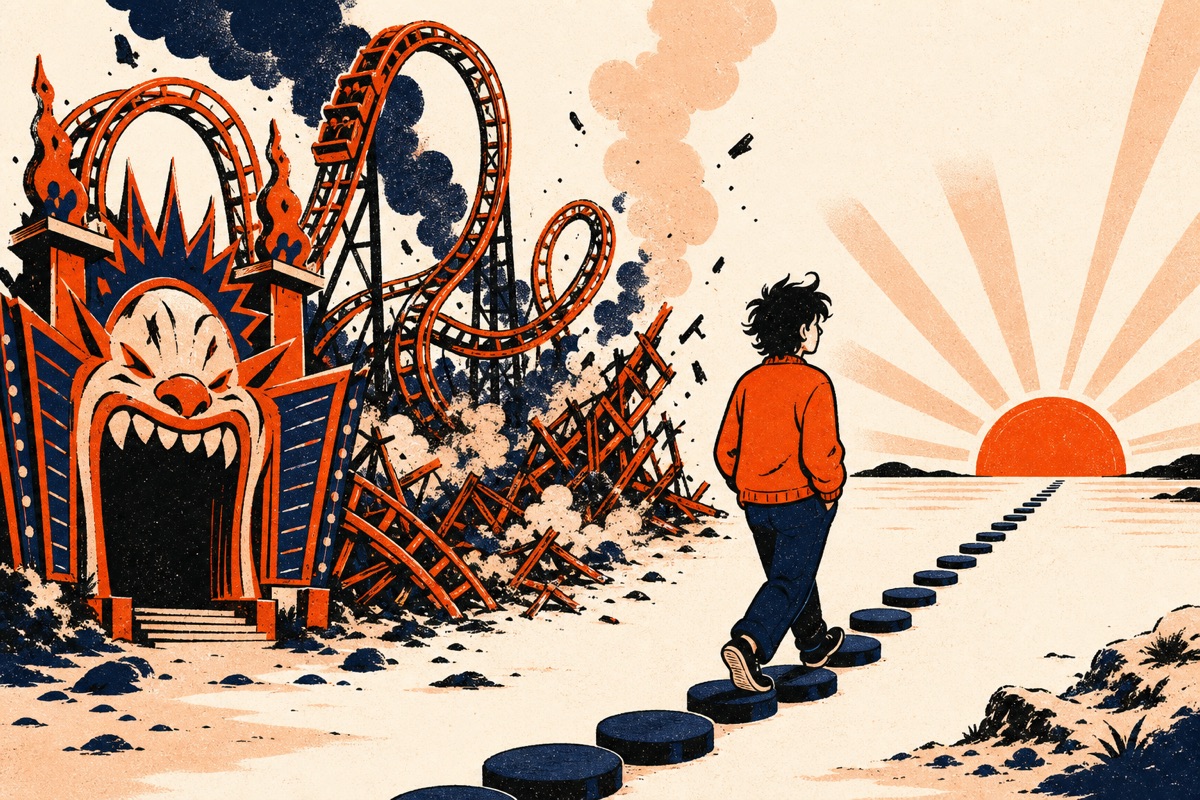
Every sleep overhaul you've launched has died the same death. Week one: new bedtime, no screens, journaling, supplements — executed with the fervor of a religious conversion. Week three: all of it gone, and you're back at 2am.
Here's the diagnosis, and it isn't laziness: you tried to fix your sleep the way you do everything — with intensity. But intensity doesn't replicate. Boring consistency does. Your circadian clock is an averaging machine. It cannot hear one heroic night. It only hears repetition.
This article is the evidence, and then the redesign.
If you read nothing else
- Inconsistency is a measured ADHD feature, not a character flaw. Across 319 studies, ADHD brains are more variable moment to moment — not slower.
- The clock only hears patterns. Students with irregular schedules had melatonin onset ~2.5 hours later than regular sleepers — at the same average sleep duration.
- Regularity out-predicts duration. In 60,977 adults, how consistent sleep timing was predicted mortality risk more strongly than how long sleep lasted.
- You cannot binge-repay sleep debt. Weekend recovery sleep clawed back ~1.1 hours and still failed to prevent metabolic damage.
- The post-crash "clarity" high is contrast, not a new state. Deficits accumulate invisibly, so the first real night of sleep feels like a drug.
Why does every sleep overhaul collapse by week three?
Because an overhaul is an intensity project wearing a consistency costume.
ADHD engagement runs on interest, novelty, and urgency. A brand-new protocol supplies all three — for about two weeks. Then the novelty is spent, the urgency is gone, and the protocol you designed at peak motivation still demands peak motivation every single night.
The overhaul didn't fail because you're weak. It failed because it was built from the fuel that runs out first.
Notice the shape of the cycle, because it repeats across your whole life: all-in, crash, guilt, new all-in. The swings feel like moral events. They're mechanical ones.
Is inconsistency actually part of ADHD?
Yes — it may be the most replicated finding in the entire literature.
A meta-analysis of 319 studies found children and adolescents with ADHD show substantially greater moment-to-moment reaction time variability than typically developing peers (effect size g = 0.76; g = 0.46 in adults). The striking part: after accounting for that variability, ADHD brains were not slower on average. The signature is not less ability — it is wider swings around the same average.
Two honest caveats. Elevated variability shows up in other clinical conditions too, so it isn't an ADHD-exclusive fingerprint. And stimulant treatment substantially reduced it in that meta-analysis — which is a data point about mechanism, and a conversation for you and your prescriber, not a recommendation from me.
The swings reach sleep directly. Across five nights of actigraphy, 38 school-age boys with ADHD showed significantly more night-to-night instability in sleep onset and duration than 64 controls — instability alone could statistically predict who had ADHD. That study is boys only, and children; in adults, a systematic review and meta-analysis found longer sleep-onset latency, lower sleep efficiency, and more awakenings than controls.
So when you say your life feels volatile — big highs, hard crashes, in work, mood, and sleep — the research agrees. Variability is the trait. Which means consistency is not your default setting; it has to be engineered.
Why does your body only respond to consistency?
Because the circadian clock doesn't take instructions. It takes statistics.
Your clock sets itself on the pattern of light and sleep timing it receives, averaged across days. One perfect night is a data point it discards as noise. This is why intensity — the one glorious 9:30pm bedtime after a chaotic month — accomplishes nothing you can keep.
The cleanest demonstration: researchers tracked 61 undergraduates for 30 days and scored the regularity of their sleep timing. Regularity was statistically unrelated to how much they slept (r = 0.05). Yet the irregular sleepers' melatonin onset — the clock's own bedtime signal — arrived about 2.5 hours later than the regular sleepers' (00:08 vs 21:32), and regularity correlated with academic performance (r = 0.37). Same amount of sleep. Scattered timing. Broken clock.
And the stakes scale up. In 60,977 UK Biobank adults wearing accelerometers, more regular sleepers had a 20–48% lower all-cause mortality risk than the least regular — and regularity predicted mortality more strongly than sleep duration did. That's an observational cohort of mostly older adults, so it proves association rather than causation. It is still the largest objective dataset we have, and it ranks the boring variable first.
Your clock cannot hear one heroic night. It can only hear a pattern.
Can't I just crash hard, then catch up on weekends?
That's the intensity pattern applied to repayment, and it's been tested directly.
In a controlled lab study, healthy adults who slept 5-hour nights across a workweek then got unlimited weekend recovery managed to claw back only about 1.1 hours of the debt. When short nights resumed — as they always do — their circadian phase had drifted later and their whole-body, liver, and muscle insulin sensitivity fell 9–27% below baseline. The weekend didn't repay the loan. It rescheduled it, with interest, and nudged the clock in the wrong direction.
Worse: you can't feel the debt accumulating. When researchers restricted people to 6 hours a night for 14 days, cognitive performance degraded to the equivalent of two full nights of total sleep deprivation — while their self-rated sleepiness plateaued after the first few days. The paper's own words: subjects were "largely unaware" of their accumulating impairment. Your gauge for "how impaired am I?" is broken precisely when you need it.
Now put those two findings together, because they explain something you've felt.
The morning after you finally sleep — really sleep — you feel limitless. Clear, funny, magnetic, breathing like you mean it. I know that morning personally; it's the closest thing I have to the movie Limitless (my experience, n=1). The mechanism above says why it happens: your baseline had been sinking for weeks, invisibly. One real night restored contrast, and the distance between where you were and where you belong feels like a drug.
That high is not a new state you unlocked. It is your old baseline, visible again. The trap is chasing it the intense way — another crash, another glorious recovery, another two magnetic days — when the entire point is that the state was your default all along. Consistency doesn't produce the high. It produces the baseline, permanently, minus the fireworks of contrast.
How do you build consistency with a brain that hates it?
Not by becoming a consistent person. By shrinking the surface area that requires consistency, then defending it structurally. Five moves, all free.
1. Anchor the wake time, not the bedtime. You cannot force sleep onset — in ADHD it runs late by design; melatonin onset arrives roughly 1.5 hours later than in non-ADHD adults. But you fully control when you wake, and wake time controls morning light, and light timing is what drags the clock earlier. Same hour every day, weekends included, held especially after a bad night. The full protocol is in the delayed sleep phase article.
2. Design for your worst week, not your best day. The overhaul asks "how much can I add?" The consistency question is "what survives the day I hate everything?" If the answer isn't "this does," shrink it until it is. A wake time and a lamp survive a terrible week. An eleven-step evening routine does not.
3. Move it from willpower to structure. Consistency executed as a nightly decision spends the exact executive resource ADHD is shortest on, at the hour it's most depleted. So remove the decision: a lamp on a timer, one alarm that means "wind-down starts," the same cue in the same order. No 11pm decision survives contact with an interesting screen — that battle has its own article.
4. Track variance, not streaks. Streak psychology is the intensity pattern in disguise: one miss reads as ruin, and ruin justifies abandonment. Measure spread instead — how far your wake times scatter across the week — and work on narrowing it. A bad night inside a regular week is noise. A "ruined streak" is only a story.
5. Spend your intensity where it pays. You don't have to give up running hot — aim it. Intensity belongs in work sprints, projects, play; it has no business in infrastructure. Sleep, wake time, meals: these are load-bearing and boring by design. Make your sleep boring so the rest of your life doesn't have to be.
What to do with this
Stop auditioning new protocols and start defending one anchor. Wake time, same hour, every day. That single boring repetition is the highest-yield move in this entire field — it's why everything on this site starts with sleep.
Retire the crash-and-recover cycle as a strategy. The weekend doesn't repay the week. The magnetic morning after a crash is your baseline showing itself, not a reward for the crash.
And reframe what the swings mean. Wide amplitude is the hardware you have — measured, replicated, real. It is also why the fixes that work for you are structural, not motivational: a clock that runs late, a mind that manufactures its own noise, a body that won't cool down — every one of them yields to boring, repeated, mechanical inputs.
Here's the version of that reframe that made control feel worth practicing to me. The engine was never the deficit — remember, the meta-analysis found ADHD brains no slower on average, just wider-swinging. But an engine that responds this hard to the pedal crashes on ordinary roads until you train the braking and the steering, and nobody handed you that training with the diagnosis.
Consistency is not a cage for the engine. It is the driver training that makes the engine usable. Stepping outside yourself to watch the gauges — the variance tracking, the fixed anchors, the structure that decides so you don't have to — is how you get the full output on the days you choose, instead of wherever the swings happen to throw you.
ADHD is not an excuse. It's a problem to solve. "I'm just an inconsistent person" sounds like a personality. It's closer to an unanchored clock — and clocks take anchors.
Questions people actually ask
Why can't I stick to a sleep schedule with ADHD?
Because schedules demand steady, low-stimulation repetition, and ADHD regulation runs on interest and urgency instead. A meta-analysis of 319 studies found moment-to-moment variability is one of ADHD's most replicated features. You are not failing at discipline; you are running consistency on hardware tuned for intensity.
Is it okay to catch up on sleep on weekends?
Catching up feels restorative but the debt does not clear. In a controlled study, weekend recovery sleepers regained only about 1.1 hours, their body clocks drifted later, and insulin sensitivity fell 9–27% once short nights resumed. Two good nights do not repay five bad ones.
Why do I feel amazing after one good night of sleep?
Because your baseline had quietly collapsed. After 14 days of short nights, people show deficits equal to two nights of total sleep deprivation while rating themselves only mildly sleepy — the decline is invisible from inside. One good night restores contrast, and the gap feels like a drug. That gap is your actual baseline.
What is the most important sleep habit for ADHD?
A fixed wake time, kept within the same hour every day including weekends — held even after a bad night. Wake time anchors light exposure, and light timing sets your circadian clock. Regularity is the one variable that large cohort data ranks above duration itself.
Is inconsistency a symptom of ADHD?
Yes — measurably. Children and adults with ADHD show greater moment-to-moment reaction time variability across 319 studies, and boys with ADHD showed more night-to-night sleep instability than controls. The variability itself, not just inattention, is the signature. Build systems that assume it rather than willpower that denies it.
Sources
- Reaction time variability in ADHD: a meta-analytic review of 319 studies — Clinical Psychology Review (2013)
- Sleep regularity is a stronger predictor of mortality risk than sleep duration: A prospective cohort study — Sleep (2024)
- Irregular sleep/wake patterns are associated with poorer academic performance and delayed circadian and sleep/wake timing — Scientific Reports (2017)
- Ad libitum Weekend Recovery Sleep Fails to Prevent Metabolic Dysregulation during a Repeating Pattern of Insufficient Sleep and Weekend Recovery Sleep — Current Biology (2019)
- The cumulative cost of additional wakefulness: dose-response effects on neurobehavioral functions and sleep physiology from chronic sleep restriction and total sleep deprivation — Sleep (2003)
- Instability of sleep patterns in children with attention-deficit/hyperactivity disorder — Journal of the American Academy of Child and Adolescent Psychiatry (2000)
- Emotion dysregulation in attention deficit hyperactivity disorder — American Journal of Psychiatry (2014)
- Delayed circadian rhythm in adults with ADHD and chronic sleep-onset insomnia — Biological Psychiatry (2010)
- Sleep in adults with ADHD: a systematic review and meta-analysis — Neuroscience & Biobehavioral Reviews (2018)
This is educational content and personal experimentation — not medical advice. Talk to your doctor before changing medication, supplements, or treatment. Full disclaimer.
The list
One protocol at a time, to your inbox.
No 30-day email courses. No PDFs you'll never open. When a protocol survives testing, you get the write-up. Unsubscribe anytime.