Wired, Hot, and Wide Awake: The ADHD Cooldown Problem
Sleep starts when your core temperature falls. ADHD is named among the conditions where that cooldown is mistimed — and the fix runs backwards from instinct.

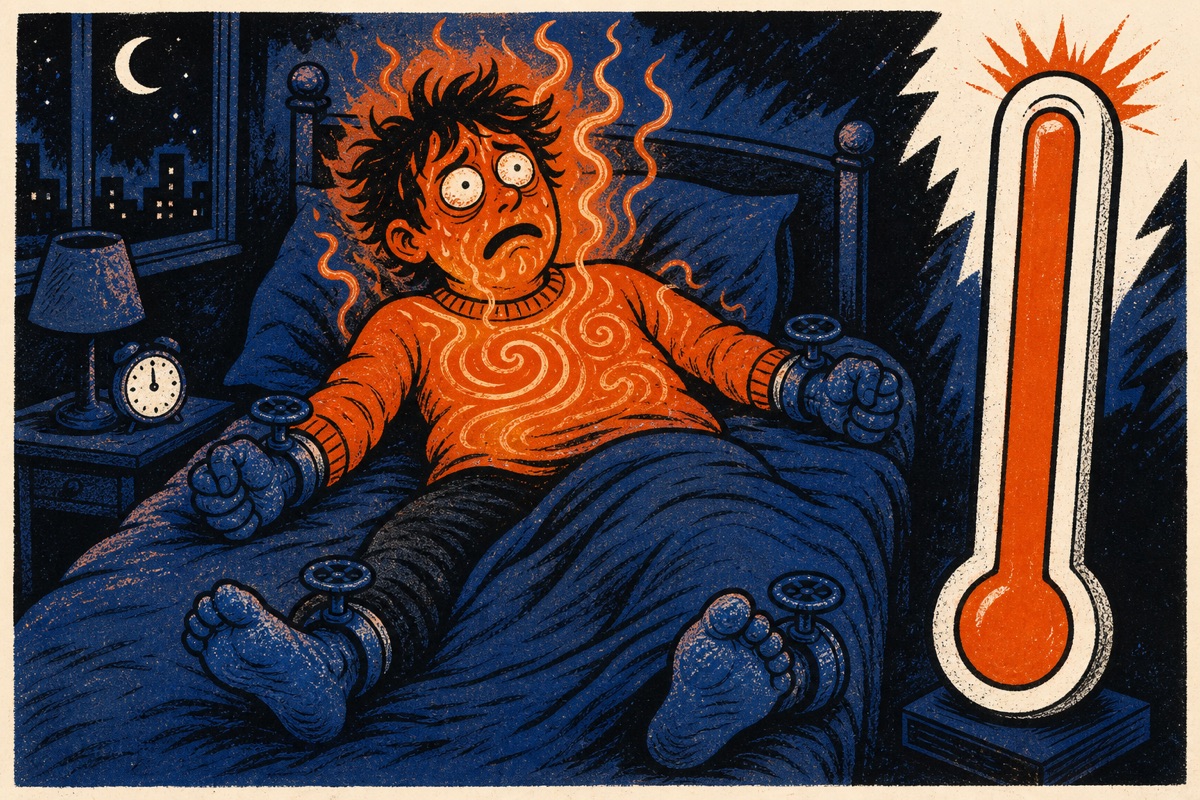
You're exhausted. You're also hot, restless, and completely wide awake — kicking a leg out from under the duvet, flipping the pillow, wondering why a tired body won't just shut down.
Here's the part nobody told you: falling asleep is a temperature event. Your core body temperature has to drop before sleep will start, and your body does that by pushing heat out through your hands and feet. When that hand-off is mistimed, you stay warm and alert — and a 2026 review names ADHD among the conditions where it goes wrong.
The fix runs backwards from instinct.
If you read nothing else
- Sleep onset is triggered by your core temperature falling, not by how tired you are. Willpower doesn't move that lever.
- Your body dumps heat through hands and feet. Cold extremities plus a hot core means the exit is shut.
- A 2026 review identifies ADHD among conditions with disrupted core-temperature rhythms — the same rhythm already known to run late in ADHD.
- You warm up to cool down. A bath 1–2 hours before bed shortened sleep onset across 13 studies. That's counterintuitive and it's free.
- Honest limit: the ADHD-specific evidence here is one recent review, not a deep literature. Strong mechanism, thin ADHD-specific data.
What actually starts sleep?
Not tiredness. Temperature.
Your core body temperature runs on a daily rhythm — peaking in the late afternoon, falling through the evening, bottoming out a few hours before you wake. Sleep onset rides that falling edge. The drop isn't a consequence of sleeping; it's part of what permits sleep to begin.
And your body has a specific way of achieving it. It opens the blood vessels in your hands, feet, and face, floods them with warm blood, and radiates heat out through the skin. Researchers measure this as the distal-proximal skin temperature gradient — the difference between your extremities and your trunk. A bigger gradient means heat is actively leaving.
Warm hands and feet are the exhaust pipe. Not a symptom of being too hot — the mechanism for getting cooler.
Which explains a complaint that sounds impossible: cold hands and feet while feeling overheated and unable to sleep. That isn't a contradiction. It's the exhaust being closed. Heat stays in your core, your core temperature holds high, and sleep onset keeps getting pushed back.
Why would ADHD make this worse?
Two reasons, and I want to be straight about how strong each one is.
The first is well established. In adults with ADHD and chronic sleep-onset insomnia, melatonin onset arrives roughly an hour and a half later than in adults without ADHD. Your circadian clock runs late. And the temperature rhythm is part of that same clock — core temperature, melatonin, and sleep timing move together. If one is delayed, the others generally are too. So when you lie down at a socially normal hour, your core temperature hasn't started its descent yet. You're trying to sleep on the wrong part of your own curve.
The second is newer and thinner. A 2026 review of thermoregulation across sleep disorders lists ADHD alongside insomnia, narcolepsy, sleep apnea, depression and restless legs as conditions in which delayed or disrupted core temperature minima, impaired distal-proximal gradient, and altered melatonin secretion prolong sleep latency and fragment sleep.
That's a real citation in a real journal, and it's the first time this has been named cleanly for ADHD. It is also one review. Nobody has run the study that measures the distal-proximal gradient in a large ADHD sample against controls. The general thermoregulation science is solid; the ADHD-specific layer is a promising lead, not a settled finding.
I'd rather hand you that distinction than oversell it. The mechanism is worth acting on because the intervention is free and the general evidence is good — not because ADHD has been proven to break it.
Why does warming yourself up make you cooler?
This is the part that sounds wrong and isn't.
If heat leaves through your skin, then warming your skin opens the exit. A hot bath floods your hands and feet with blood, widens the distal-proximal gradient, and dumps core heat faster than doing nothing would. You come out of the water warm — and then your core temperature falls further and faster than it otherwise would have.
The evidence is unusually good for something that costs nothing. A meta-analysis of 13 studies found that a warm bath or shower, scheduled 1–2 hours before bedtime for as little as 10 minutes, significantly shortened sleep onset latency and improved both sleep efficiency and self-rated sleep quality. The trials used water around 40–42.5°C — hot, not scalding, and worth being careful with if you have any circulatory or blood-pressure condition.
The timing is the active ingredient, and a larger study pins it down. In 1,094 adults, bathing 61–180 minutes before bed significantly shortened measured sleep onset latency and raised the distal-proximal gradient in the 30 minutes before bed — the mechanism showing up directly in the data. That was an older-adult cohort, so read the exact minutes as a guide rather than a prescription.
A bath immediately before bed is the version that doesn't work. You need the window for the heat to actually leave.
When the heat is telling you something else
What to do with this
Stop treating bedtime heat as a discipline problem. It's a plumbing problem. You are not failing to relax; your body is failing to move heat, and that has levers.
Work the gradient, not the thermostat. Cranking the aircon while your hands and feet stay cold makes the trapped-heat problem worse, not better. Warm extremities plus a cool room is the combination that moves heat. That ordering is the whole insight.
Fix the clock underneath it. If your temperature rhythm is late because your whole circadian system is late, the bath is a nightly patch on a structural problem. The structural fix is shifting your body clock — and it's the reason everything here starts with sleep.
And check what else is keeping you up. Bedtime arousal that feels physical can be a mind that won't idle, it can be something in the room you're allergic to, or it can be a drug that sedates without actually delivering sleep. Heat is one channel. It's rarely the only one.
ADHD is not an excuse and it isn't a character flaw — it's a problem to solve. "I'm too hot and too wired to sleep" sounds like a personality. It's closer to a mistimed thermostat, and thermostats have settings.
Questions people actually ask
Why do I feel too hot to fall asleep?
Sleep onset depends on your core body temperature falling, and your body sheds that heat through your hands and feet. If that heat dumping isn't happening on schedule, you stay warm and alert. The feeling of being too hot is often the cooldown failing, not the room.
Why are my hands and feet cold but I still feel overheated?
That combination means heat is trapped in your core instead of moving outward. Warm hands and feet are how the body dumps heat — cold extremities mean the vessels aren't open, so your core temperature stays up and sleep onset gets pushed back.
Does a warm bath before bed actually help you sleep?
Yes, and it's one of the better-evidenced free interventions. A meta-analysis of 13 studies found a warm bath or shower one to two hours before bed shortened how long people took to fall asleep. Warming the skin drives heat out, so your core drops faster.
Is the ADHD cooldown problem an established diagnosis?
No. A 2026 review names ADHD among conditions with disrupted core-temperature rhythms, and the general thermoregulation science is solid. But the ADHD-specific evidence is one recent review, not a deep literature. Treat it as a promising explanation, not settled fact.
Sources
- Thermoregulation in sleep disorders: comprehensive review — Journal of Clinical Medicine (2026)
- Before-bedtime passive body heating by warm shower or bath to improve sleep: a systematic review and meta-analysis — Sleep Medicine Reviews (2019)
- Hot-water bathing before bedtime and shorter sleep onset latency are accompanied by a higher distal-proximal skin temperature gradient in older adults — Journal of Clinical Sleep Medicine (2021)
- Delayed circadian rhythm in adults with ADHD and chronic sleep-onset insomnia — Biological Psychiatry (2010)
- Distal skin temperature is reduced in individuals with trait vulnerability to stress-related sleep disturbance — American Journal of Physiology - Regulatory, Integrative and Comparative Physiology (2025)
This is educational content and personal experimentation — not medical advice. Talk to your doctor before changing medication, supplements, or treatment. Full disclaimer.
The list
One protocol at a time, to your inbox.
No 30-day email courses. No PDFs you'll never open. When a protocol survives testing, you get the write-up. Unsubscribe anytime.