ADHD Revenge Bedtime Procrastination: Why You Won't Go to Sleep
Exhausted but you refuse to sleep — scrolling, gaming, anything. That's revenge bedtime procrastination, and the ADHD brain does it for a reason. Here's the fix.

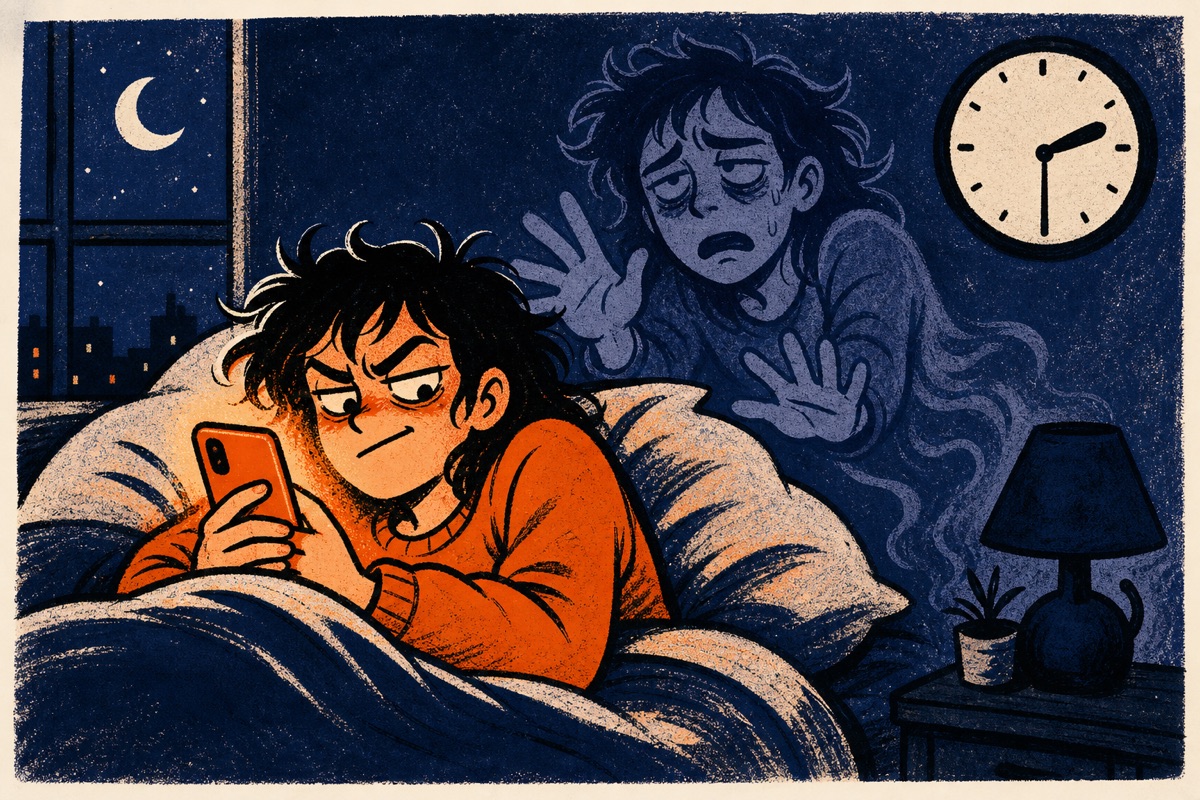
You're wrecked. You have to be up in six hours. And you are choosing, with full awareness, to watch one more video. Then one more. It's 2am and some stubborn part of you would rather be exhausted tomorrow than give up this night.
That's revenge bedtime procrastination — and if you have ADHD, you're not weak for doing it. You're doing something that, underneath, makes complete sense.
If you read nothing else
- Revenge bedtime procrastination = staying up late on purpose to reclaim time you feel you lost during the day, even though you're tired and nothing's stopping you sleeping.
- The ADHD version is fueled by three stacked forces: a delayed clock, a dopamine-starved brain, and depleted impulse control by nightfall.
- It is not a discipline problem. It's an under-fed brain getting its only meal at the only time it's allowed to.
- The fix attacks the causes — feed the brain by day, shift the clock, make wind-down rewarding — not your willpower at midnight, which is the weakest lever you own.
First: this is a real, named thing
In 2014, sleep researchers gave it a name: bedtime procrastination — "failing to go to bed at the intended time, while no external circumstances prevent you." They found it tracks with lower self-regulation and not enough sleep. The internet added "revenge," borrowing a Chinese phrase (报复性熬夜) for staying up to take back a day that belonged to everyone but you.
So the first thing to know: you didn't invent a personal failing. You're doing a documented human behavior — and the ADHD brain does it on hard mode.
Why the ADHD brain does it harder — three forces stacked
1. Your clock is genuinely more awake at night
This isn't in your head. In ADHD adults with sleep problems, the body's "wind-down" signal (melatonin) arrives about an hour and a half late. So at 11pm, when you're "supposed" to be sleepy, you're biologically running where a typical brain was at 9:30 — alert, capable, ready to do things. The night doesn't feel like bedtime because, to your clock, it isn't. (Full mechanism: why your brain won't sleep until 3am.)
2. The night is the day's best dopamine
Here's the emotional engine. All day your under-stimulated brain white-knuckles through obligated, boring, low-dopamine tasks. Then night comes: quiet house, nobody needing anything, no obligations. For a brain that's been starving for stimulation all day, the free night is the richest meal available — and it's the only meal that's entirely yours. Giving it up to sleep doesn't feel like rest. It feels like surrendering the one part of the day you were allowed to enjoy.
That's the "revenge." You're not procrastinating sleep. You're refusing to let a draining day end without getting something back.
3. The brake is offline by midnight
The part of you that would say "go to bed" — impulse control, executive function — runs on the prefrontal cortex, and it's running on empty by late evening. ADHD taxes it to begin with; a long tiring day drains what's left. So at exactly the hour you most need to override the impulse, you have the least ability to. This is why willpower fails here specifically, and why "just have more discipline" is useless advice.
Why you can't willpower your way out
Notice what those three forces have in common: not one of them is a motivation problem. Your clock is a biological setting. The dopamine pull is a real need going unmet. The missing brake is a depleted resource. Telling yourself to "just go to bed" attacks none of them — it just adds shame on top, and shame is itself understimulating, which sends you back to the phone.
So we don't fight it at midnight. We change the conditions so midnight-you doesn't have to fight at all.
The fix: change the causes, not the willpower
Feed the brain during the day. If the night is your only source of stimulation, you'll always defend it. Give your brain real input earlier — movement, genuinely interesting work, controlled stimulation while you do the boring stuff (a fan, music, body-doubling). A brain that got fed by day doesn't need to raid the night. This is the single most overlooked fix.
Shift the clock so night stops feeling like your prime time. Morning light within the first hour and a fixed wake time, every day, slowly pull your alert window earlier. When your body actually starts winding down at a reasonable hour, the pull to stay up weakens on its own. It takes two to four weeks and it's boring — and it works. (Here's exactly how.)
Make the wind-down a reward, not a punishment. The reason bed loses to your phone is that bed is boring and the phone isn't. So don't make wind-down a sensory desert. Give it a managed dose of stimulation — a familiar audiobook, steady sound, something the brain can hold loosely. Bed has to compete, so let it. The racing-thoughts protocol is built for exactly this.
The honest part
Some nights you'll still do it. A shifted clock and a fed brain lower the pull; they don't delete it. The goal isn't a perfect record — it's turning "every single night, out of my control" into "sometimes, and I know why." That's not failure. That's a pattern you finally understand well enough to change.
And it all sits on the same foundation as everything else here: fix your sleep first, because a rested ADHD brain has more of the exact resource — impulse control — that revenge bedtime procrastination steals.
Next: Why your brain won't sleep until 3am — the circadian mechanism →
Questions people actually ask
What is revenge bedtime procrastination?
Staying up late on purpose — scrolling, gaming, watching — even though you're tired and nothing is stopping you from sleeping. The 'revenge' is reclaiming personal time you feel you didn't get during the day. It was formally described by sleep researchers in 2014 and is especially common in ADHD.
Why do people with ADHD do revenge bedtime procrastination?
Three things stack: a delayed body clock means you're genuinely more alert at night, the quiet obligation-free night is the day's richest source of dopamine for a stimulation-hungry brain, and the impulse control that would send you to bed is depleted by late evening. It's an under-fed brain finally getting fed.
How do I stop revenge bedtime procrastination with ADHD?
Attack the cause, not the willpower. Feed your brain enough stimulation during the day so the night isn't its only source, shift your delayed clock earlier with morning light and a fixed wake time, and make the wind-down itself mildly rewarding instead of a punishment. Willpower at midnight is the weakest lever you have.
Is revenge bedtime procrastination a real thing or an excuse?
It's real and documented — researchers introduced 'bedtime procrastination' as a distinct behavior in 2014, and it correlates with lower self-regulation and short sleep. Naming it isn't an excuse; it's the first step to solving it, because you can't fix a pattern you think is just a character flaw.
Sources
- Bedtime procrastination: introducing a new area of procrastination — Frontiers in Psychology (2014)
- Delayed circadian rhythm in adults with attention-deficit/hyperactivity disorder and chronic sleep-onset insomnia — Biological Psychiatry (2010)
- The circadian rhythm in adult attention-deficit/hyperactivity disorder: current state of affairs — Expert Review of Neurotherapeutics (2013)
This is educational content and personal experimentation — not medical advice. Talk to your doctor before changing medication, supplements, or treatment. Full disclaimer.
The list
One protocol at a time, to your inbox.
No 30-day email courses. No PDFs you'll never open. When a protocol survives testing, you get the write-up. Unsubscribe anytime.